This post is part of a series that charts the history of photography since the 1900s. The series takes a decade by decade look at how the skills a photographer needs have changed in light of technological, economic and societal change.
Documentary Photography
Industrialisation presented a shift from agrarian living to urbanisation in many western European countries. A move to the cities inevitably led to an increased interest amongst photographers to document that shift.
Eugene Atget’s (1857-1927) work in particular is notable for recording much of Paris’ decaying architecture and has an almost ghost-like quality (see below).
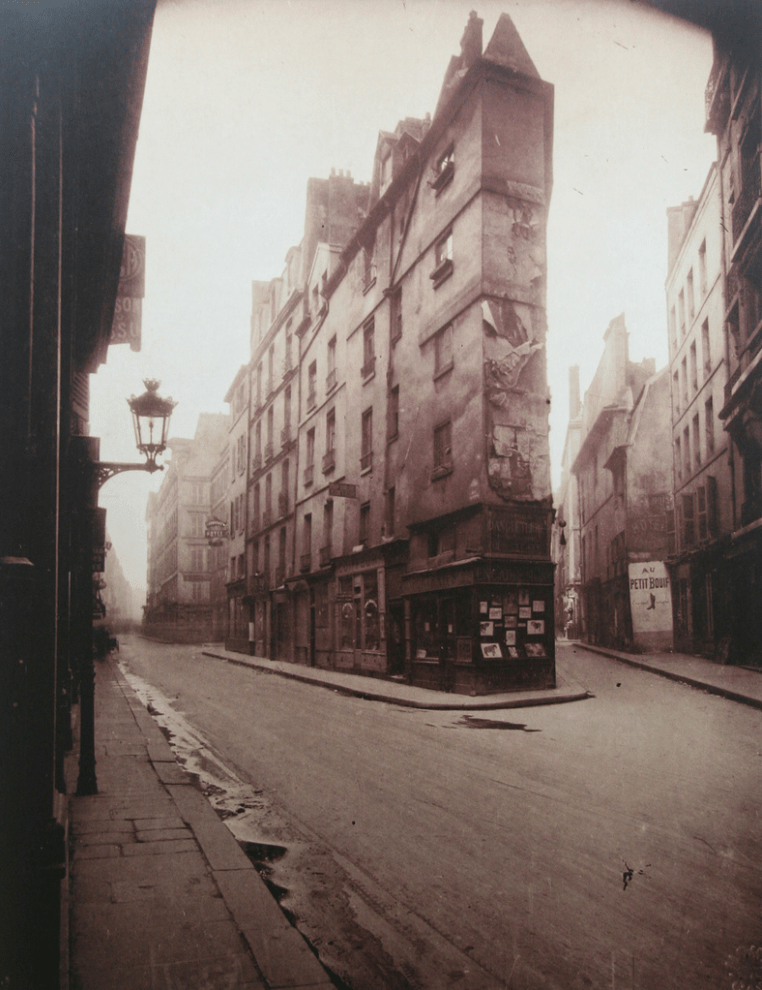
Atget is an exponent of straight photography and the sepia shades that suffuse A Corner, Rue de Seine (above) imbue his work with a nostalgic air.
Atget would often venture out into the streets of Paris in the early hours when few people were around and use long exposure times, so that if people did happen by they appeared as nothing more than ethereal spectres (Stepan, 2017). This reflected the transience of the times – Atget’s Paris was slowly dying, but his photography in many ways is an attempt to immortalise its passing.
Popularity of the motor car
By the late 1920s automobile production was at its zenith in France and it’s during this period that we begin to see them feature more prominently in photographs (Cohen, 1991). In his autobiography Man Ray (2012) recounts a Kerouacian anecdote of when he and Francis Picabia went on a road trip around the south of France:-
“I saw more and more of Francis Picabia; besides photographing his works, I made a number of portraits of him. He liked especially to be photographed behind the wheel of one of his great cars … He drove very fast … the landscape began to change, with budding plane trees along the road, the gray-green olive trees, red-tiled stone farm houses surrounded by black poplars, and quaint towns with vestiges of Roman ruins … And when the blue Mediterranean came into sight, I was thoroughly captivated.”
(pp. 196-7, Man Ray, 2012)

There’s a distinct romanticism about the idyllic scene. This presaged new applications for photography – it had already made its way into the world of fashion, but it would also play a significant role advertising products of the emerging industries.
Relevant Photography Skills in the 1920s
- Advertising: Rotogravure printing triggered a switch in magazine content away from articles towards advertising, because of the higher quality images (Smith, 2018). This meant that the market for photography had changed and we see an increase in what we might call product photography. An understanding of visual language, especially in the use of using sexual imagery to sell products, saw what Smith calls a blurring of the line between art and commerce (Smith, 2018).
Over the years a number of theories have been applied to photography to help the viewer ‘read’ images (Barthes, 2000; Saussure, 1995; Berger, 1972, to name but a few). An understanding of these theories help us to explore the deeper meanings within images that help advertisers to influence the way their audiences perceive their clients products and services.
Often these deeper meanings are not explicitly apparent and the viewer is open to interpret the meaning based on factors such as their social class, ethnic group, sexual orientation, and personal bias, amongst others:
“The photographer steers viewers into a conceptual ballpark, then encourages them to
(Suler, 2013)
decide for themselves what in particular the photo might mean. If we see in a photo a
pack of cigarettes on a table, next to a line of cocaine and a pair of dice, with someone’s folded hands in the background, the concept seems to be “addiction,” but the exact meaning is open to interpretation.”
By understanding and exploiting the characteristics that make up the viewer in an advertiser’s intended audience of the image can be an incredibly powerful tool.
- Sales and negotiation: Dealing with a range of companies to photograph their products for magazines and other advertising channels would have involved negotiating skills on behalf of the photographer. Many of these photographers would have been working freelance and would not have been employed directly by the magazines or the product owners. This would require a good deal of initiative and an understanding of the market, with a portfolio of contacts.
Enjoying the series? Jump back to the 1910s or forward to the 1930s.
References
Barthes, R. (2000). ‘Camera Lucida.’ Vintage Books.
Berger, J. (1972). ‘Ways of Seeing.’ Penguin Books.
Man Ray. (2012). ‘Self-portrait.’ Penguin Classics.
Saussure, F. (1995). ‘Course in general linguistics.’ Duckworth.
Stepan, P (2017). ’50 Photographers You Should Know.’ Prestel
Suler, J. (2013). ‘Conceptual photography.’ 4th edition. [Online]. Available at: https://www.academia.edu/12424755/Conceptual_Photography [Accessed 8th March 2023].
 Scott's Unfinished Pictures
Pingback: What skills does a photographer need today? The 1910s. | Scott's eLearning Library
Pingback: What skills does a photographer need today? The 1930s | Scott's eLearning Library