
This post is part of a series that charts the history of photography since the 1900s. The series takes a decade by decade look at how the skills a photographer needs have changed in light of technological, economic and societal change.
Surrealism
Surrealism flourished in the 1930s, borne out of the earlier Dada movement.
Surrealism, steered by André Breton, was committed to reconciling the irrational and rational sides of human nature. The origins of Surrealism are contested. For some, the roots are reputed to lie in Rayographs (eponymously named after Man Ray). In 1922 Man Ray published his first Rayograph, Les Champs délicieux which included a foreword by Tristan Tzara (see below).

The Rayograph was yet another experimental technique pioneered quite by chance when Man Ray accidentally left a blank piece of paper in the developing tray. The process is also referred to as ‘solarisation’ meaning to expose a partially developed photograph to light, which creates a halo-like effect around the subject (Tate, ND). As Man Ray waited in vain for an exposure to appear he realised his mistake, but instead decided to place objects on the wet paper and turned on the light to create silhouettes of the objects that came out distorted (Man Ray, 2012). After a visit from Tristan Tzara the two experimented with the process further, astounded by the mysterious and innovative effect, completely in fitting with the tenets of Dada.
American artist Lee Miller is also credited with developing the solarisation technique and became an influential figure in the Surrealist movement in late 1920s Paris. Miller had started out as a model, posing for the likes of Man Ray and featured in Vogue magazine, but she also later became a celebrated war photographer capturing the horrors of world war two (Villa, 2021).

In Miller’s Exploding Hand (see above) she plays with reflections to turn a relatively mundane scene into an unusual one.
Presenting a Surrealist scene in a photograph as opposed to a painting posed challenges, as photographers did not have the luxury of depicting a scene from their vivid imaginations, but had to draw on real life and portray it in an idiosyncratic way that distorted that reality (V&A, ND).
In 1936 the International Surrealist Exhibition was held in London and showcased the work of John Havinden’s Per Annum (see below). Notables from the Dada movement, such as Hans Arp and Man Ray, were involved too, along with the Surrealism founder André Breton.
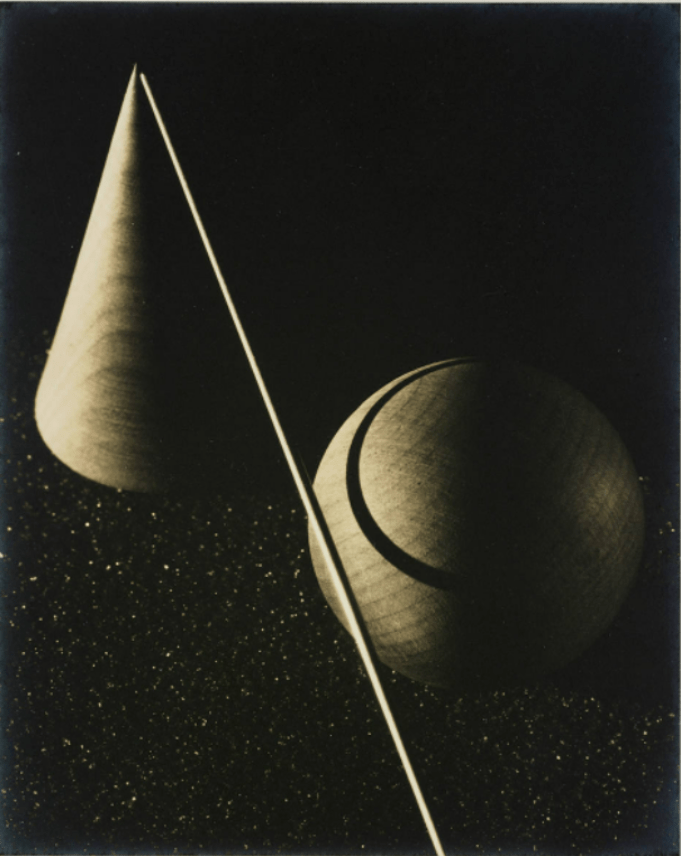
Havinden’s Per Annum is a good example of how Surrealism can apply a modernist lens to everyday geometric objects. The lighting in Per Annum lends a mysterious, otherworldly cast to the objects, and allows the viewer to lose themselves in an implied cosmos that only exists in their perception.
Relevant photography skills in the 1930s
Imaginative use of props: Surrealism lends itself to those who can think ‘outside the box’ and use props imaginatively, as with Havinden’s Per Annum. Props are often useful to modern photographers too, as they can help to support a scene or suggest a particular visual concept or message.
Enjoying the series? Jump back to the 1920s or forward to the 1940s.
References
Man Ray. (2012). ‘Self-portrait.’ Penguin Classics.
Tate (ND). ‘Dada.’ [Online]. Available at: https://www.tate.org.uk/art/art-terms/d/dada [Accessed 19 April 2022].
V&A (1930). ‘Surrealist Photography.’ [Online]. Available at: https://www.vam.ac.uk/articles/surrealist-photography [Accessed 19 April 2022].
Villa, A. (2021). ‘Photographer Lee Miller’s subversive career took her from Vogue to war-torn Germany.’ Art in America [Online]. Available at:https://www.artnews.com/feature/lee-miller-photography-vogue-man-ray-1234587240/ [Accessed 19 April 2022].
 Scott's Unfinished Pictures
Pingback: What skills does a photographer need today? The 1920s. | Scott's eLearning Library
Pingback: What skills does a photographer need today? The 1940s. | Scott's eLearning Library
Pingback: Photographing the Moon (Surrealism) | Scott's Unfinished Pictures