
This post is part of a series that charts the history of photography since the 1900s. The series takes a decade by decade look at how the skills a photographer needs have changed in light of technological, economic and societal change.
Mick Rock
The 1970s was an exciting period for music and the British photographer, Mick Rock (1948-2021), took many iconic images of the rock artists of the time. The decade saw the glitz and flamboyance of Glam Rock give way to the edgy New Wave and Punk scene, all of which provided excellent opportunities for the photographer to explore.
Bizarrely though, Rock fell into photography by chance. He recounts the story that a photography career wasn’t really considered to be a serious choice. For him, initially at least, it was more a case of getting his parents off his back about getting a career:
‘I remember the day a friend told me about a band that needed some publicity photos. They were not signed to a record label, and they had just five English pounds as their budget. That stirred me. So it was possible to make money from photography!! I had not considered that.
(Rock, 2022).
I had found a way, albeit inadvertently and modestly, to placate my parents’ concerns about how I could make a living, at least temporarily, because very few photographers at that time actually did make a living. The media was very primitive in the early ‘70s. Not the all-pervasive beast that it is today in our digital age.’
Rock’s observation about photography being the “all-pervasive beast” that it is today tells us how much things have changed since the 70s. It’s worth reflecting on how the ubiquitous use of the photograph today has impacted on the profession as a whole. There’s a strong argument to say that photographers today need to do everything possible to differentiate themselves from what an amateur could do with a smartphone camera – otherwise, why would a client bother with the expense of a photographer?
Rock took many groundbreaking photographs of musicians through the ages, such as David Bowie, Queen, Blondie, Lou Reed and the Sex Pistols to name but a few. Perhaps his most famous has to be of David Bowie’s alter ego, Ziggy Stardust, in the early 1970s.
Ziggy Stardust
In the image below, we see a good example of how Rock captures the whimsical side of Ziggy Stardust, where his reflection faces the camera via a mirror. Interestingly, in the same decade (1977), Sontag published her groundbreaking book ‘On Photography’ where she compares photography to Plato’s allegory of the cave, suggesting that photographs, like shadows, can overtake and supersede reality. In the 1970s, Bowie himself loved to court pretension and adopt roles where the viewer always saw him through the lens of one of his fictional characters.
This photograph exemplifies that aspect of Bowie’s character perfectly: we don’t see him directly but rather as a reflection of his real self.
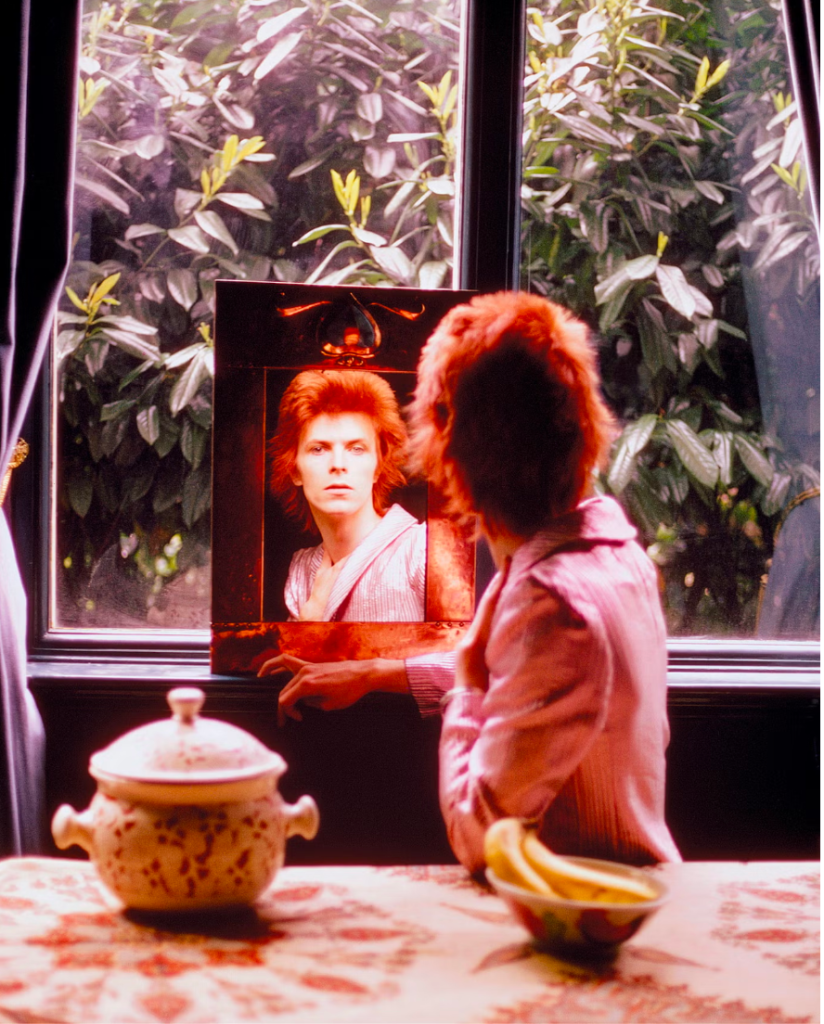
Vibrant colours are also a hallmark of Rock’s work. The reds and greens complement each other in this photograph (they’re opposites on the colour wheel). Red is also suggestive of danger and the planet Mars, the ‘red planet’, where Bowie’s fictional character is reputed to be from.
Relevant Photography Skills in the 1970s
- Keeping abreast of popular culture: Opportunities for photography can arise in unexpected places, as they did for Mick Rock. A smart photographer is always on the lookout to capture the zeitgeist of the times, whether that’s new developments in the music scene, or elsewhere.
- Formal education: This can be a decisive issue, as Präkel observes:
‘There are some working photographers with no formal education in photography. There are even those who say you do not need a formal education – your portfolio alone will get you jobs. These observations are true but they apply only to the very lucky, the very talented and the very persistent. The rest of us need a hand-up.’
(Präkel, 2010).
Do photographers need a formal education? Could we class that as a ‘skill’? A formal education certainly provides the kind of environment where many skills are developed and allowed to flourish. However, Rock’s personal story also proves that with determination and enthusiasm, you can go far.
Enjoying the series? Jump back to the 1960s or forward to the 1980s.
References
Präkel, D. (2010) ‘The Fundamentals for Creative Photography.’ AVA Publishing, SA.
Rock, M. (2022). ‘Shot! By Rock: The photography of Mick Rock.’ Weldon Owen.
 Scott's Unfinished Pictures
Pingback: What skills does a photographer need today? The 1980s. | Scott's eLearning Library
Pingback: Photography: “The all seeing eye.” | Scott's eLearning Library