This post is part of a series that charts the history of photography since the 1900s. The series takes a decade by decade look at how the skills a photographer needs have changed in light of technological, economic, and societal change.
Nan Goldin
In 1980, the French literary theorist and philosopher, Roland Barthes, wrote Camera Lucida, which explores the very nature and purpose of photography. In this seminal work Barthes illustrates how the photographer can use images to evoke strong emotions to engage the viewer and there is perhaps no better example of this than Nan Goldin.
Nan Goldin was an American photographer and activist who didn’t shy away from the more seedy subculture of drugs, alcohol and sex that came with the 1980s.
Born in 1953, Washington DC, her formative years were marked by fraught family relationships, sexuality and the suicide of her older sister. A troubled child (Goldin was only fourteen at the time of her sister’s suicide), she lived in a number of foster homes before taking up photography at the age of sixteen (Badger, 2014). In 1978 she moved to New York and lived in the metropolis throughout the 1980s where her gritty photography documented LGBT subcultures, moments of intimacy and abuse, as well as the HIV/AIDS crisis.
Her most notable work is “The Ballad of Sexual Dependency” (1986), a monograph that captures the gay subculture and features many of her family and friends. Goldin used photography as a vehicle to shine a light on many under-represented (and often, misrepresented) groups that did not have a voice at that time. Intimacy is a hallmark of her work and many of her photographs have a personal resonance (Graf, 2023).
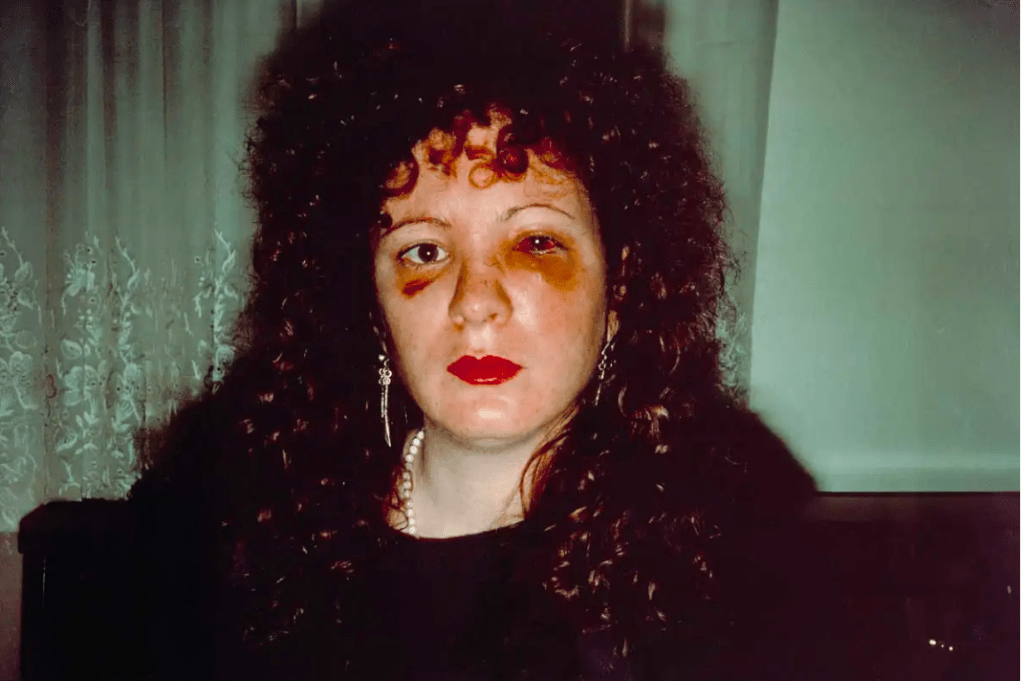
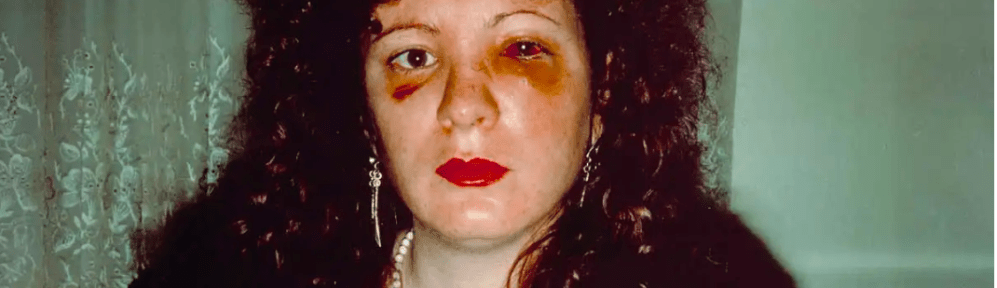
The work Nan one month after being battered (see above image) is part of her The Ballad of Sexual Dependency set, which centres around relationships, drug use, parties, sex and most strikingly of all, how we can develop a dependency on all these destructive impacts on our lives, as the title suggests. The glamour that often goes with such themes is stripped away in Goldon’s images. Instead we often get the darker side of human relationships; relationships that are frequently corrosive.
To illustrate the personal nature of her work, not only is Goldin featured in the image, but the physical abuse evident in the photograph comes from her own boyfriend (Brian). Goldin is quoted as describing their relationship as “dominated by jealous passion, sexual obsession, and interdependence.” (Graf, 2023). The two were together for several years and Brian is often featured in her photographs.
Throughout Camera Lucida (1980) Barthes dissects the art of photography from the viewpoints of the photographer (operator), the viewer (spectator), and the subject of the photograph (spectrum). Barthes argues that the very act of posing for a photograph has an impact on the subject (spectrum), which has a knock on effect for the photographer (operator). This relationship contributes to how we feel as a viewer (spectator) of the image and can evoke strong emotions. Given that in the image above, Goldin is both the subject (spectrum) and the photographer (operator) that relationship becomes further conflated. Goldin is effectively using the image in a very autobiographical way to tell the viewer (spectator) what has happened to her. How does that make you feel? Behind her vulnerability and “battered” physical state (apparently her beating was so severe that Goldin almost lost an eye) in the image, there is an underlying bravery for exposing what has happened to her that commands respect from the viewer.
Goldin used the camera as a tool to document places and people she met, and raise awareness about social issues in order to advocate for change. There’s an element of autobiography to her work, that some may find shocking or distressing, but her work also provides a platform for people to speak out
Relevant Photography Skills in the 1980s
- Raising awareness of social issues: Goldin’s work makes us question “what is the purpose of photography?” It doesn’t have to be about creating beautiful images, it can be used as a vehicle to affect social change.
That could potentially take the documentary photographer to some dark (and potentially dangerous) places. I would argue that taking the kinds of images Goldin has, takes a certain degree of fortitude and courage. If your intention is to affect social change through photography then you are likely to meet with a fair measure of resistance too!
Enjoying the series? Jump back to the 1970s or forward to the 1990s.
References
Badger, G. (2010) ‘The Genius of Photography.’ Quadrille Publishing, London
Barthes, R. (2000). ‘Camera Lucida.’ Vintage Books.
Graf, S. (2023). ‘7 photographs by Nan Goldin that you need to see.’ In The Collector [Online]. Available at: https://www.thecollector.com/nan-goldin-photographs/ [Accessed 4th July 2023].
 Scott's Unfinished Pictures
Pingback: What skills does a photographer need today? The 1990s. | Scott's eLearning Library