
How do you create drama in your drawings?
This is something I’ve been reflecting on recently, as it’s tricky to get right. As ever, you learn from your mistakes, and feedback from others is also enormously helpful. I don’t profess to have all the answers, but I’d like to share some of the things I’ve learnt along the way.
Subject matter
As many of you may know, I like to draw dark fantasy scenes that are typically dripping with drama and a sense of peril anyway. So I’m halfway there already, right? Dark fantasy drawings often include monsters of some description, either inspired by mythology or conjured up out of the febrile imaginations of various fantasy authors.
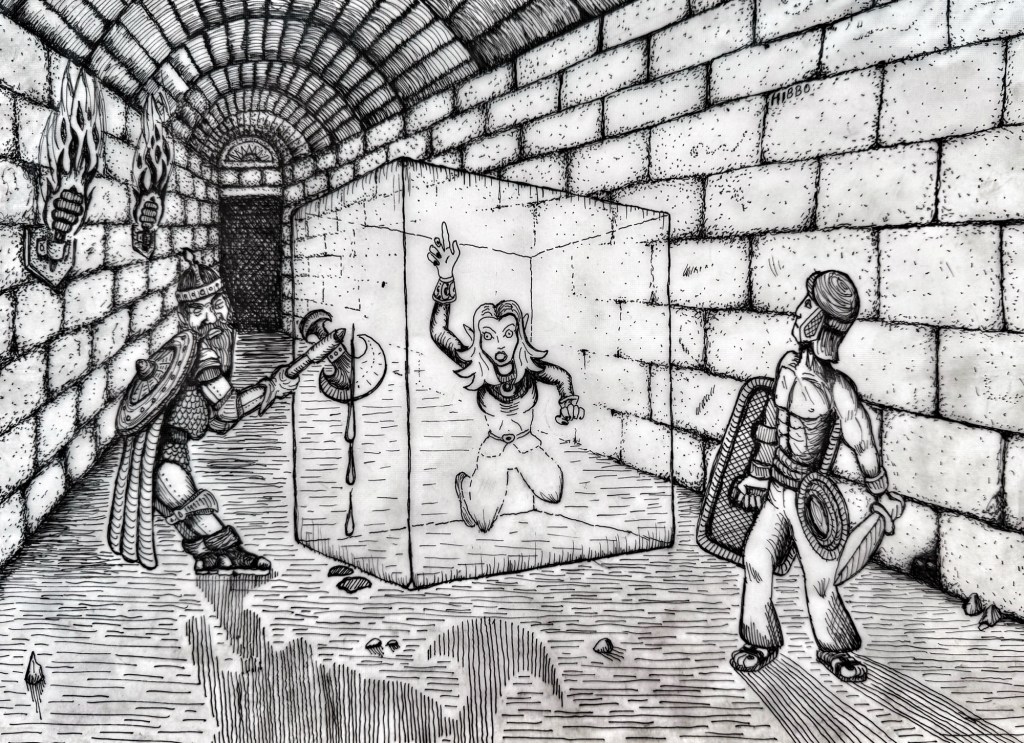
The sketch below includes the notorious ‘Gelatinous Cube’—an’ almost invisible enemy that traps unsuspecting victims in its mass and slowly dissolves them. If you’ve seen the classic 50s horror movie The Blob you’ll get the idea. But how do you draw something that you can’t see?
Facial expressions
Monsters evoke horror and revulsion. Consider how you portray these strong emotions in those witnessing the horror. In the sketch above, I have three people in the drawing, but all are doing different things:
- One is trapped in the invisible cube and is struggling to get out. For this, I’ve tried to convey a sense of shock and terror (open mouth screaming, eyes wide, arms flailing, etc).
- The one with the axe is battling the monster and is trying to free his axe from the side of the creature. Here I’ve tried to convey strain and exertion with his grimace as he tries to pull the axe free. This is reflected in his posture too.
- The third warrior is considering his next move and is trying to work out where the monster actually is (he appears to be looking above it). Did it drop from the ceiling?
The key is to convey action; action equals drama!
Black and white
Consider what style you want to use to detail the scene. I love drawings in black and white using inks because they’re so atmospheric.
Would this image work the same if it were in colour? I often like to take black and white photographs for the same reason. The contrast can be quite stark and greatly add to the drama of the image.
Shadow
I’ve talked about shadows in previous posts and try to use them as much as possible to create tension.
Consider where you place the light source in the image to maximise the use of shadow. In this case I have a transparent blob for the monster that doesn’t cast a shadow, so it doesn’t work as well as I’d like. However, there’s still an opportunity to create the shadows of the adventurers to create drama. With hindsight, I should have created more foreground in this image to maximise the shadow of the hero with the axe, but I ran out of space. This could have been avoided if I’d planned the composition out more carefully in advance.
The type of light source is worth considering too. Flickering torchlight that is imperfect works well.
Place
What is the location of the image? Where is the drama taking place?
For this image, I’ve used a catacomb with a vaulted ceiling, but there are many options available that can contribute to the drama. Just keep in mind the action that is taking place in the scene to generate the drama. The location needs to be a realistic backdrop for such action.
 Scott's Unfinished Pictures