
The moon has been a source of fascination to humans for thousands of years. As Earth’s only natural satellite, some 238,856 miles away, it’s little surprise that the moon is often the subject of countless photographs too.
In February 2007, NASA launched the THEMIS mission. The mission consisted of five satellites programmed to study energy releases from the Earth’s magnetosphere. The magnetosphere is responsible for phenomena at the Earth’s poles, such as the Aurora Borealis.
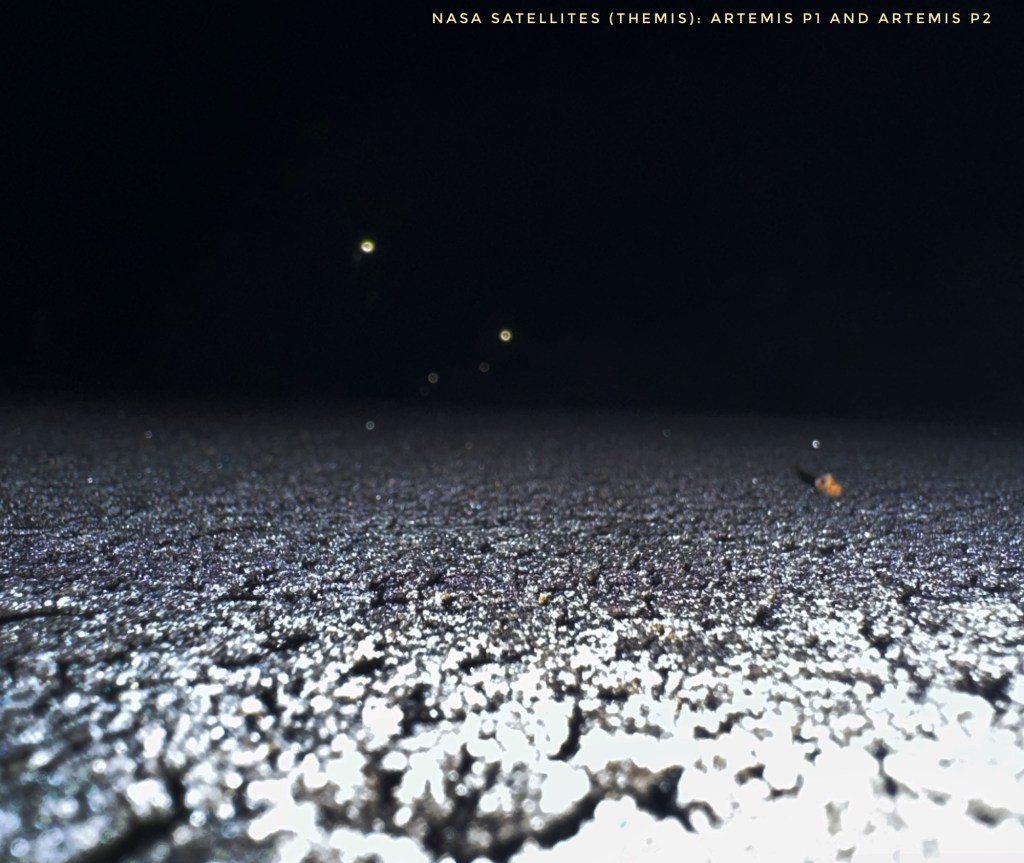
Three of the satellites orbit the Earth, but two (Artemis P1 and Artemis P2 in the photograph) orbit the moon. The Classicist in me was immediately drawn to these two satellites and their striking names (Artemis is the Greek goddess of the moon).
It’s intriguing to consider that the data these satellites collect are helping to further our understanding of what makes the world go round (literally). Who could believe that one simple photograph could say so much?
The Illusion of Surrealism
But of course, the image isn’t really of the satellites orbiting the moon, nor does it come from NASA.
That’s what surrealist photographers do: They present you with something quite mundane and hoodwink you into believing it’s something else. Something alien, sublime, beyond the limits of our comprehension. Our imaginations can create all manner of realities, given the right nourishment.
The above image is my homage to this style. Let me break down the illusion – the photograph was taken outside my house on a winter morning. What you actually can see is frost on the ground with two ordinary street lights in the distance. The caption on the photograph is also fabricated, designed to give the image an air of authenticity.
Were you fooled?
If so, then forgive me my parlour trick, but Surrealism teaches us a valuable lesson. In a world driven by so much technology, AI and the misinformation and bias that comes with it – question everything!
(If you’re interested in surrealism, I discuss its origins in an earlier post and some of its leading photographers).
 Scott's Unfinished Pictures