
One of my favourite things about a vacation is idling away the time reading books I enjoy. Often this involves recapturing my youth and immersing myself in the many rich stories of Greek mythology. On my recent break to Greece (Skiathos) I had the pleasure of reading Paul Cartledge’s fascinating book ‘The Spartans.’
In Classical Greece, Spartans were not conventional Greeks, and a more modern mythology, fuelled by movies, literature and art, also conflates our perceptions further.
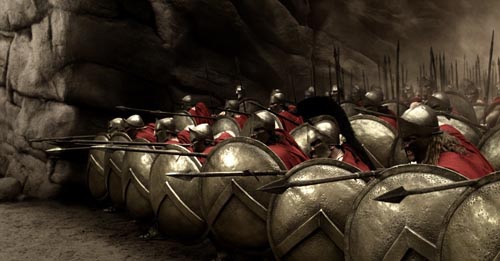
In the violent world of Classical Greece, where city-states (poleis) often defined themselves by their military prowess, the Spartans distinguished themselves as the warrior elite par excellence.
In this post I want to explore the importance of the iconic Spartan shield within its broader Greek context, while addressing modern misconceptions about its role and representation.
A brief history of the aspis
The shield is known as the aspis in Greek, although the term hoplon is sometimes used to denote the shield (where the term ‘hoplite’ derives). However, the latter is more of a generic term (especially when used in the Greek plural hopla) to describe the weapons and armour of a Greek infantryman, and not just the shield.
While shields across Greek city-states were broadly similar in design, Sparta’s approach to the shield, both in its symbolic weight and its role within the phalanx, distinguished it as something much more than a mere defensive necessity.
Prior to the military reforms of Philip II of Macedon in the late fourth century BCE, Greek hoplite shields showed little variation in construction across city-states. Made of a wood and reinforced with stretched layers of hide and a bronze-facing, the aspis was designed to provide maximum protection.
In the Greek Heroic Age there are accounts of shields using multiple layers of hide, these variations were likely individual or regional rather than standardized city-specific choices. Presumably the more layers of hide, the greater protection the shield offered, but there would be a trade-off in expense and encumbrance. In Homer’s Illiad (Book 7) Ajax’s shield is famously described as having seven layers of hide. This embodied his role as the bulwark of the Greeks and helped to portray the hero’s colossal strength. Shield diameter remained consistent with necessity dictating size, but thickness could vary based on materials available or the wealth of the individual soldier.
Decoration, contrary to modern depictions in film and popular culture (I’m getting wonderful childhood flashbacks of the Jason and the Argonauts movie from the 60s…), did not follow standardized heraldry. Shields were not typically painted, nor were they uniformly adorned with city or unit insignias until very late in Greek military history.
Bronze decoration, including rims and symbolic embossments, was the norm. These symbols could be apotropaic (meant to ward off evil), religious, or personal in nature. They were not typically used to denote military units or city affiliation until the idea of state-issued, professional military gear emerged during the later Hellenistic era.
Brouwers notes that shield blazons, when they were used, were often meant to terrify one’s opponents. Perhaps the most famous example of this in Homer’s Illiad is Athene’s shield, the Gorgoneion, decorated with the head and face of a Gorgon, a terrifying creature with snakes instead of hair and capable of turning onlookers to stone with a single glance.
Spartan Exceptionalism and the Lambda
Among all Greek city-states, Sparta is the notable exception.
Though early Spartan shields were decorated much like those of other poleis, over time the letter Λ (lambda)—standing for Lacedaemon, the region of Sparta—became a widely recognized symbol emblazoned on Spartan shields. When this occurred exactly is open to speculation. A fragment from a lost comedy by Eupolis, writing during the time of the Peloponnesian war (431-404 BCE) uses the metaphor “gleaming lambdas” to describe the Spartan shield, suggesting this would have been common knowledge to a late fifth century Greek audience.
Unlike the decorative or mystical symbols seen elsewhere, the lambda served a dual purpose: it was both a regional identifier and a symbol of communal unity. While not evidence of early military uniformity in the modern sense, it was a deliberate act of identity construction, reinforcing the cohesion and singularity of the Spartan war machine. The Spartans would have been well aware of their military reputation and the distinctive lambda-embossed shield, along with their red cloaks, would have no doubt helped to intimidate and unnerve their foes before battle even commenced.
The presence of the lambda should not, however, be misunderstood as an early example of mass-issued military insignia. Spartans were still citizen-soldiers, responsible for maintaining their own arms and armor.
Yet this collective adoption of the lambda served as a powerful expression of the ethos that permeated Spartan society—a society which prized discipline, conformity, and the subordination of the individual to the needs of the state.
The Shield as Social and Moral Instrument
Perhaps more than in any other Greek city-state, the shield in Sparta carried immense social and moral significance too.
The famous Spartan saying referencing shields cited in Plutarch provides further insight into the Spartan mentality:
“Come back with your shield, or on it.”
This pithy phrase, attributed to Spartan mothers, conveys the expectation that their sons would either return victorious, holding their shield, or if they died in battle, their body would be carried home upon their shield. It stresses the importance of honour and valour. To return without your shield implies cowardice in battle.
Unlike the sword or spear, which could be dropped or lost in the chaos of battle, the shield protected not only the bearer but also the man to his left in the phalanx formation. To abandon one’s shield was to betray one’s comrades and, by extension, Sparta itself.
This moral dimension extended into the realm of personal identity. For Spartans, the shield was not merely equipment; it was an extension of the self and the community. It symbolized not just martial capability, but also discipline, reliability, and solidarity.
Myths and Misunderstandings
Contemporary portrayals of ancient Greek warfare often conflate hoplite traditions across centuries and regions, leading to persistent myths—among them, the romantic notion of the “farmer-hoplite.”
In truth, hoplites were drawn from the upper echelons of society, capable of affording the costly armour and weapons necessary for battle. The idea of rustic yeoman farmers grabbing shields to defend democracy against tyranny is largely a modern anachronism, reinforced by literature and cinema rather than archaeological or textual evidence.
Additionally, while we now associate Spartan shields with the lambda, it is important to remember that this was not always the case. In earlier periods, Spartan shields were as varied in decoration and symbolism as those of other Greeks. It was only through deliberate cultural choices that Spartans gradually unified their battlefield imagery, culminating in the iconic red cloak and lambda-emblazoned shield recognized today.
Conclusion: More Than Protection
The Spartan shield offers a compelling window into Classical Greek military culture, revealing a convergence of practicality, symbolism, and social ideology. While its physical construction remained consistent with that of other city-states, its symbolic and moral dimensions set it apart. The lambda, the phalanx, and the cultural imperatives that surrounded shield use in Sparta together reveal a society uniquely attuned to the power of symbols and the imperatives of collective identity.
Understanding the Spartan shield not merely as a tool of war, but as a vessel of meaning—carried into battle not just to protect but to proclaim—reminds us that even the most utilitarian objects can carry profound cultural weight.
 Scott's Unfinished Pictures